
What is a Legal Nurse Consultant? Your Complete 2026 Guide
Mar 30, 2026
If you are a registered nurse who has ever felt burned out by long shifts, physically demanding patient care, or rigid hospital schedules, you are not alone. Thousands of nurses are discovering a high-value career pivot that lets them use their clinical expertise in an entirely new arena: the courtroom.
A legal nurse consultant (LNC) is a registered nurse who applies their medical knowledge to assist attorneys, insurance companies, and healthcare organizations in understanding and resolving medically related legal cases. They do not practice law, but their clinical insight is often the difference between a case won and a case lost.
In this complete 2026 guide, you will learn exactly what an LNC does, how much they earn, what skills are required, and how to launch your own LNC career.
Quick Takeaways |
|
• A legal nurse consultant bridges the gap between medicine and law. • LNCs earn $100–$300/hour as independent consultants. • No law degree is required. Your RN license is the foundation. • LNCs work with plaintiff attorneys, defense firms, and insurance companies. • The role is flexible, remote-friendly, and highly in demand. |
What Does a Legal Nurse Consultant Do?
At its core, a legal nurse consultant relays complex medical scenarios to a Jury. The conduct reviews medical records, interpret clinical findings, and translate healthcare information into language that attorneys and juries can understand. Their work helps legal teams build stronger arguments, identify case strengths and weaknesses, and find expert witnesses.
Common tasks and responsibilities of an LNC include:
- Reviewing and summarizing medical records, pathology reports, and imaging studies
- Identifying deviations from the accepted standard of care in malpractice cases
- Researching relevant medical literature and clinical guidelines
- Preparing chronological medical timelines for case presentations
- Assisting in drafting medically accurate legal documents and interrogatories
- Locating and evaluating medical expert witnesses
- Educating attorneys and jury members on complex medical topics
- Providing support in personal injury, workers' compensation, and product liability cases
LNC vs. Bedside Nurse: How Do They Compare?
If you are considering the transition from clinical nursing to legal consulting, the differences are significant and mostly favorable for nurses seeking more autonomy and earning power.
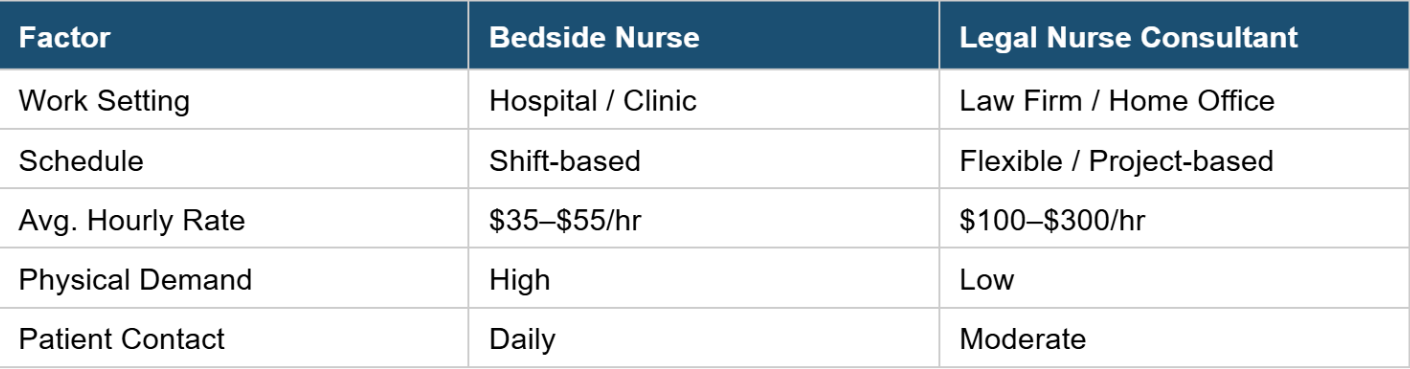
The shift from bedside care to legal consulting is not just a career change; it is a lifestyle upgrade for many nurses who want to monetize decades of clinical experience without the physical toll of direct patient care.
Who Needs Legal Nurse Consultants?
LNCs are in demand across a broad range of industries and organizations. Understanding who your potential clients are is essential if you plan to work as an independent consultant.
- Plaintiff and defense law firms handling medical malpractice cases
- Personal injury attorneys dealing with accident-related injuries
- Insurance companies reviewing claims and managing risk
- Government agencies, including the Department of Justice and Veterans Affairs
- Hospitals and healthcare systems for risk management and compliance
- Workers' compensation boards and managed care organizations
- Pharmaceutical and medical device companies in product liability cases
How Much Does a Legal Nurse Consultant Make?
Compensation for LNCs varies depending on whether you work as an employee or an independent consultant, but the earning potential is substantially higher than in most clinical nursing roles.

Independent LNCs who build a strong client base and develop a specialty niche, such as oncology malpractice or surgical complications, often out-earn their salaried counterparts by a wide margin.
What Qualifications Do You Need to Become an LNC?
Minimum Requirements
-
Active Registered Nurse (RN) license in good standing
-
At least 5 years of clinical experience (more is better)
-
Strong written and verbal communication skills
-
Analytical mindset with attention to detail
-
Management or Board Certifications are helpful as well but not required
Recommended Credentials
-
Bachelor of Science in Nursing (BSN) or higher
-
Speciality clinical certifications in your area of focus
-
Completion of an LNC training course such as the LNC Launch Academy
While a law degree is not required, basic knowledge of legal terminology, civil procedure, and courtroom processes will make you a significantly more effective consultant.
How to Become a Legal Nurse Consultant: Step-by-Step
- Gain solid clinical experience - ideally 5+ years in a relevant speciality
- Complete an LNC training program (The RNHomeOffice.com LNC Launch Academy, or similar)
- Study the legal system - learn key terms, the civil litigation process, and malpractice law basics
- Build your portfolio - develop work products and deliver them to attorneys to get started
- Market your services - LinkedIn, attorney referral networks, the LNCMasterminds.com mentorship network
Is the Legal Nurse Consultant Role Right for You?
The LNC career is an excellent fit for nurses who are:
- Clinically experienced but physically or emotionally exhausted from direct patient care
- Detail-oriented and comfortable analyzing lengthy documents
- Strong communicators in both writing and speaking
- Interested in working independently or running their own business
- Looking for higher income with more flexible hours
It may not be the right fit if you thrive on hands-on patient interaction, are not comfortable working alone for long stretches, or are not willing to invest in additional training upfront.
Frequently Asked Questions About Legal Nurse Consultants
Do I need a law degree to become an LNC?
No. A current RN license is the baseline requirement. Knowledge of the legal system is helpful but can be acquired through training programs. You do not need to attend law school.
Can I work as an LNC part-time?
Yes. Many LNCs begin part-time while still working clinical shifts. Independent consulting is highly flexible, and cases can be managed on a project basis around your existing schedule.
How long does LNC training take?
Some LNC certificate programs take up to 12 months and up to $25,000 in tuition to complete. The LNCC certification exam requires at least 2,000 hours of LNC experience before you can sit for it. Many programs are just as effective and significantly less expensive. The LNC Launch Academy by RNHomeOffice.com ranges between $997 and $5999 and takes 6 weeks to complete.
Is LNC work remote-friendly?
Largely yes. Medical record review, research, and report writing can all be done remotely. Some LNCs attend depositions or court proceedings in person, but this is only rarely required.
Not sure where to start?
We’ve created a free, step-by-step checklist to guide your transition from bedside nursing to legal nurse consulting.
Inside, you’ll discover:
- Training options
- Certification requirements
- Proven marketing strategies
- A ready-to-use client pitch template
👉 Download the Free LNC Checklist
Start your LNC journey today. Your clinical experience is worth more than you think.
Final Thoughts
The legal nurse consultant role is one of the most strategic career moves available to experienced registered nurses. It leverages everything you have spent years building, clinical expertise, critical thinking, and professional credibility- and applies it to a growing, well-compensated field.
Whether you want to supplement your nursing income, escape the physical demands of bedside care, or build a full-time consulting practice, the LNC path offers real flexibility and real earning potential.
Ready to take the next step? Download our free LNC Career Launch Checklist and start building your roadmap today.